
Emergency guides
What to Do in the First Hour After a Water Leak
By Dal Beggs, founder and owner of 1 Call Restoration. Published November 1, 2026. Updated November 1, 2026.
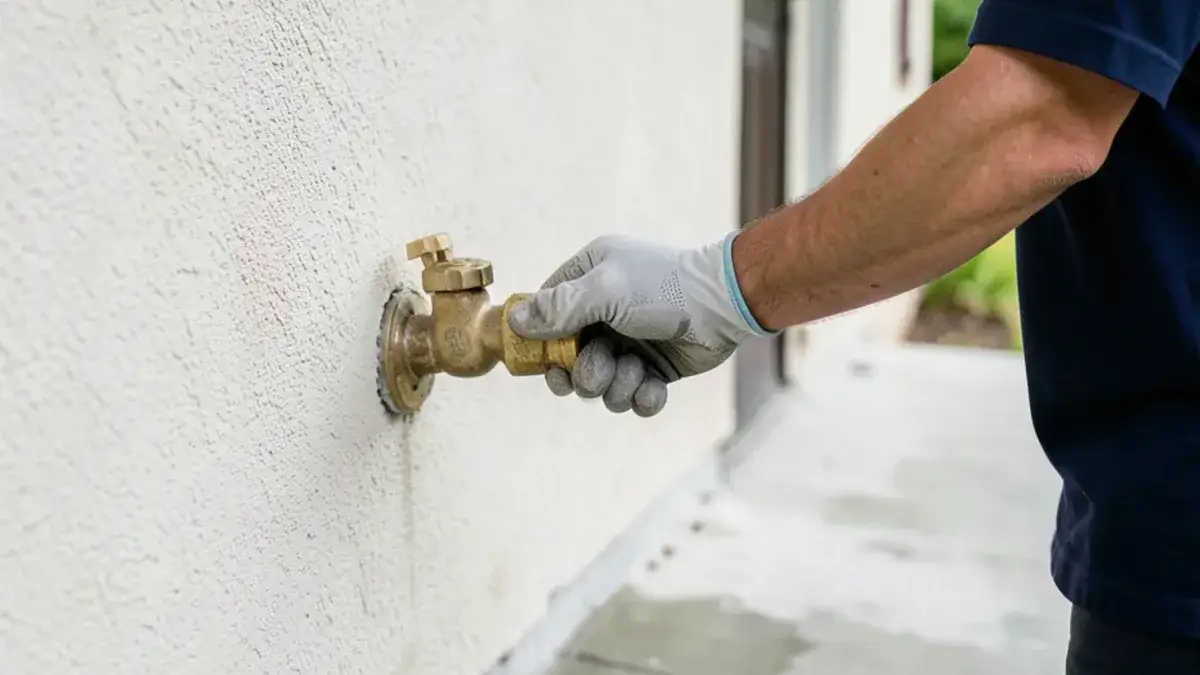
What to do after a water leak comes down to four moves in the first hour: stop the water, make the power safe, record the damage, and move what you can. Do them in that order. EPA says wet areas and items should be dried within 24 to 48 hours to prevent mold, so your clock is running.
Why does the order of your first moves matter?
Stop the source before anything else. Every gallon you keep out of the house is a gallon that never reaches the subfloor, the wall cavity or the cabinet base. Mopping while the line still runs is an easy way to lose the hour.
Power comes second because the risk is to you, not the house. CDC says that if circuits or equipment got wet, or sit in or near water, you should turn power off at the main breaker. If the panel sits on the far side of standing water, stop and call an electrician instead.
Leak still running? Call now and we will talk you through it
Open 24 hours for emergencies. Non-emergency calls are best between 7am and 7pm.
- 5.0 on Google, 8 reviews
- Family owned since 2020
- Calls go straight to the owner
- Free assessments and estimates
Your first hour, minute by minute
Use this table as a sequence, not a stopwatch. If a step is unsafe, skip it and move on.
| When | Do this | Why it comes here |
|---|---|---|
| First 5 minutes | Close the fixture valve or the main | Nothing else helps while water is still flowing |
| Next 5 minutes | Shut off power to wet rooms, only from dry ground | Water and live circuits are the real danger |
| By minute 15 | Photograph and video every wet room before moving things | Once items move, the first record is gone |
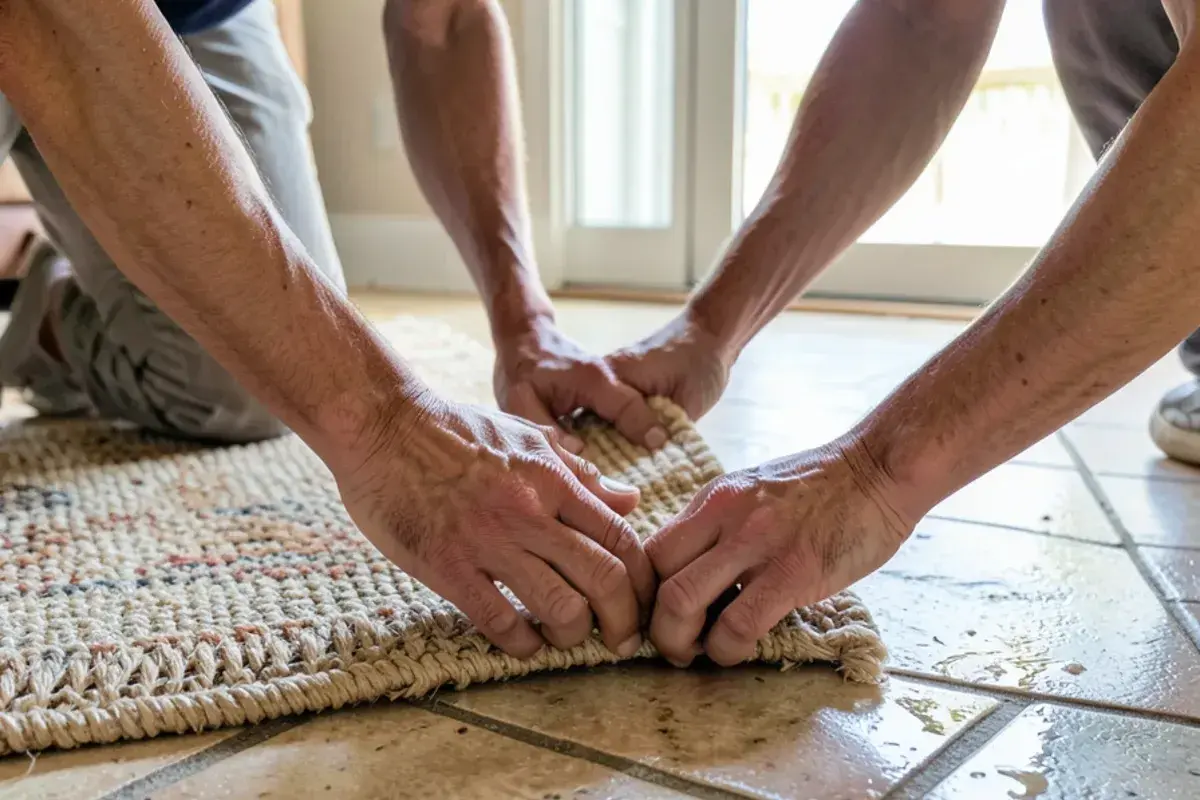
| By minute 30 | Lift rugs, electronics, papers and anything that bleeds color | Wet dye and wet cardboard stain finished floors |
| By minute 40 | Write down when you found it and what failed | The details fade fast and you will be asked |
| By minute 60, sooner if it is spreading | Call for help, and call your insurer if you plan to | Extraction goes faster than drying |
What belongs in that first record
Two minutes of phone work is enough, as long as it happens before things move. Keep the record whether or not you expect to file a claim, because it cannot be rebuilt later. Whether to report the loss is a question for you and your insurer, and our guide on filing a water damage claim covers what comes next.
- A walking video from doorway to doorway through each wet room
- A close shot of the failed part, still in place
- The model label on any appliance involved
- The time you found the water and the time the valve closed
Find the right shutoff before you hunt for the leak
Close the nearest valve that stops the water, then look for the cause. People lose time tracing a wet stain through a wall while the line behind it keeps feeding.
Fixture and appliance valves
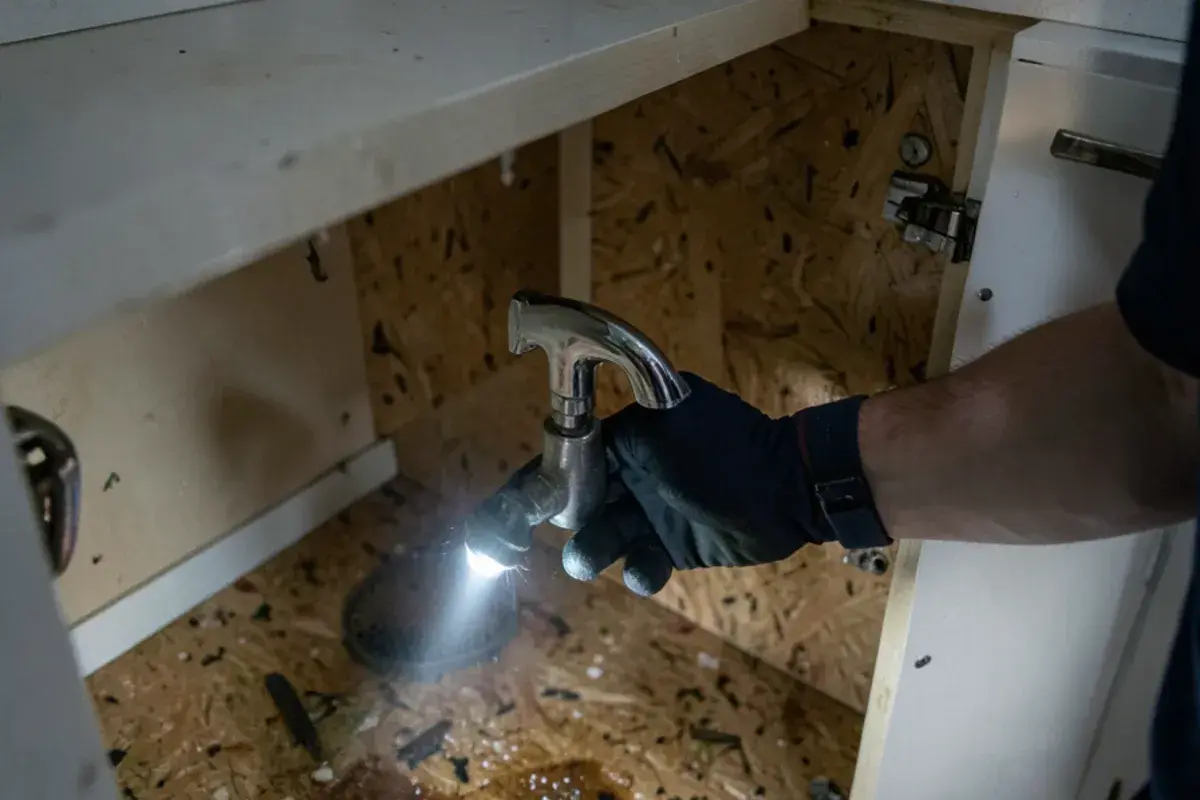
Sinks, toilets, dishwashers, refrigerators and washing machines each have a small valve on the supply line, usually behind or below the fixture. Turn it clockwise until it stops. Some older valves seize, so do not force one hard enough to snap it. Go to the main instead.
The main shutoff
Most Florida block homes have a main valve where the line enters the house, often near the front hose bib or garage wall. If you cannot find it, the utility's meter box at the street is the fallback. Water heater leaks need one more step: close the cold line at the top of the tank and shut off the heater's power or gas.
Once the main is closed, open a low faucet to bleed pressure from the lines.
What to do after a water leak that no valve will stop
The main only stops pressurized supply water. Match your source to a row below before you trust a closed valve, because three of these six leaks ignore it completely.
| What is leaking | What stops it | What will not |
|---|---|---|
| Supply line, hose or faucet | The fixture valve, then the main | Tape, towels or a bucket |
| Water heater tank | The cold valve, then a plumber draining the tank | The valve alone, since the tank empties through the leak |
| AC drain pan or line | The system switched off at the thermostat | The main, since this water condenses out of your air |
| Line inside a slab or wall | The main | Any fixture valve |
| Toilet, tub or floor drain backing up | Using no water anywhere in the house | The main. Stay clear, since it can be sewage |
| Roof or window during a storm | Nothing from inside until the weather passes | Climbing up in the rain. Catch the drip and move contents |
A backup is a different job from a leak, so read what not to touch in a sewage backup before anyone picks up a mop.
Rules we follow when a leak is still active
These are the habits we want every homeowner to borrow before we get there:
- Keep out of standing water near outlets, appliances or lit fixtures.
- Leave any light switch alone if the wall behind it is wet.
- Put no household vacuum on water, since most are not built for it.
- Treat water through a ceiling light as an electrical problem first.
- Keep windows closed on humid days, even when it feels wrong.
- Set furniture legs on foil or plastic so stain does not transfer.
- Keep any failed part, such as a burst hose or cracked fitting.
That window rule surprises people. On St. Augustine Beach the outside air often carries more moisture than the air inside, so open windows feed the problem instead of drying it. We close the room up and let dehumidifiers pull water out of a controlled space.
When is a leak beyond a mop and a fan?
Call when water has gone anywhere you cannot reach. A cup on a tile floor is a towel job. Water under flooring, behind a baseboard or above a ceiling is not, because fans only move air across a surface.
These signs mean the job has moved past DIY:
- Water reached carpet pad, drywall or insulation.
- The leak ran for hours before anyone found it.
- More than one room got wet.
- The water came from a drain, toilet or anything outside.
- You smell something musty or sour.
Fast water extraction comes first, because equipment cannot dry a floor that still holds water. After that, structural drying works from a moisture map, using air movers and LGR dehumidifiers, and we read the same spots every day until they match dry materials elsewhere in the house.
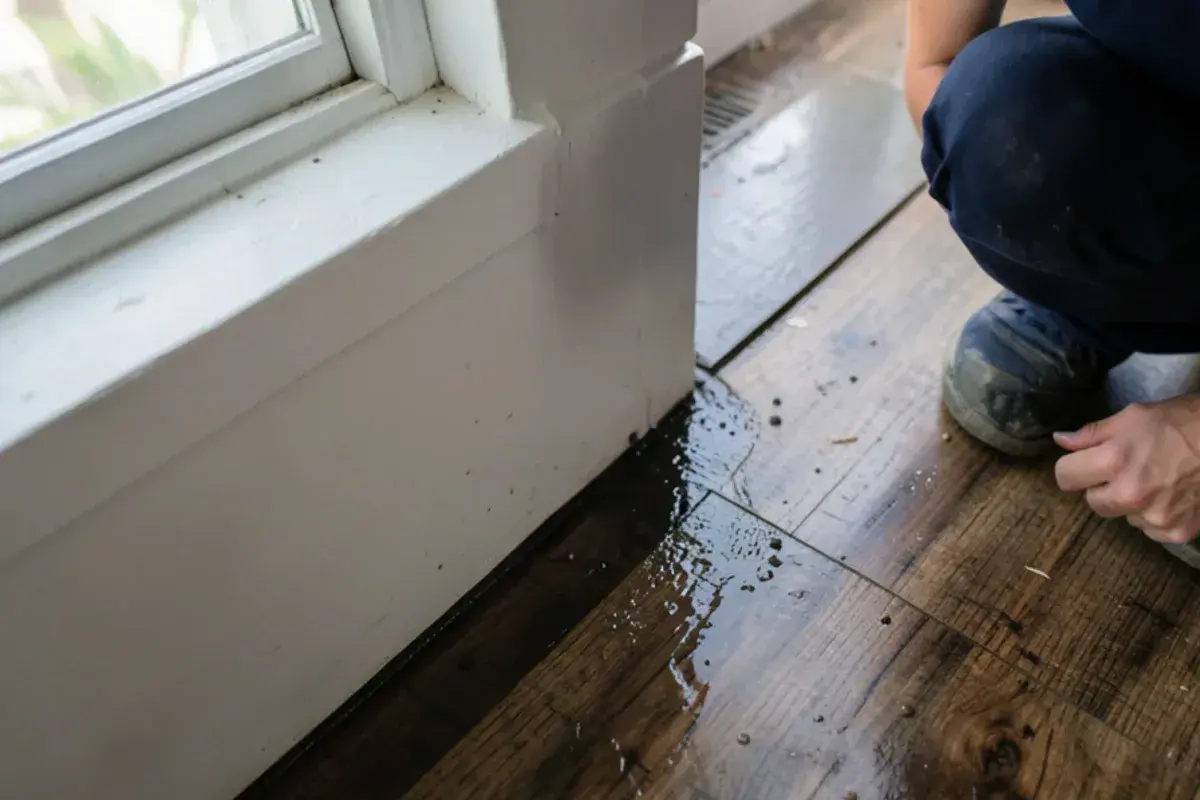
If anything in that list applies, or a pipe let go in the middle of the night, treat it as an emergency water damage call. Non-emergency questions are best between 7am and 7pm, but a leak that is still spreading can come in at any hour.
Plumber or drying crew: who do you call first?
Call the plumber first only when you cannot stop the water yourself. Once a valve holds, the repair can wait a little and the wet materials cannot, so the drying call moves to the front. The two jobs are separate: a plumber fixes the failure, and we remove the water and dry what it reached.
The trade-off is the water supply. If a fixture valve holds, the rest of the house keeps working and the plumber can come during normal hours. If only the main holds, you are weighing a night with no water against an after-hours plumbing bill. That is your decision, and neither answer hurts the drying.
Three smaller calls in the same hour
- Mop or leave it? Mop on tile when water is creeping toward wood, carpet or a doorway. Otherwise spend the time on the record.
- Photos or lifting? If a rug or a box is about to soak through, take the walking video, then lift. Careful close-ups can follow.
- Condo or rental? Tell the association or landlord in the same hour, since water may reach the unit below and the shutoff may sit in a shared closet. Who pays when a condo leak reaches the unit below is its own question.
One call after the valve is closed
Your call goes straight to the owner, and that is the point of it. We assess the damage in person, price it at no charge and skip the high-pressure sales. You will know how far the water went and what happens next before anyone cuts into a wall.
If you only need to know whether your leak is a towel job, ask. The full process is laid out under water damage restoration in St. Augustine, but the first step is the same either way: get the water stopped, and then pick up the phone.
Frequently asked questions
The leak has stopped and the floor looks dry. Am I done?
Not yet, because a dry surface says little about what sits under it. Water runs under baseboards, into wall bottoms and beneath flooring, and it stays there after the top layer looks fine. We check with moisture meters and thermal imaging, then compare readings with unaffected materials in the same home. If they match, you are done. If they do not, the wet area gets dried before it becomes a mold problem.
Should I turn the air conditioning off after a leak?
Leave it running if the air handler, ductwork and wiring stayed dry, since CDC lists air conditioning among the ways to dry a home. Shut it off if the leak came from the unit itself, if water reached the equipment, or if you see or smell mold. EPA cautions against running fans once mold has started, because moving air can spread it. When you are unsure, turn it off at the thermostat and ask.
What should I do about a bulging, wet ceiling?
Stay out from under it and cut power to that room at the breaker. A sagging ceiling is holding water and can drop without warning, so move people, pets and furniture away first. Do not poke it unless you have no other way to protect what is below. Put a bucket under any drip, close the supply if you can, and call. Ceilings that have held water need drying from above as well as below.
Valve closed and floor still wet? Call and we will come assess it
Open 24 hours for emergencies. Non-emergency calls are best between 7am and 7pm.
- 5.0 on Google, 8 reviews
- Family owned since 2020
- Calls go straight to the owner
- Free assessments and estimates
1 Call Restoration, Saint Augustine, FL. (208) 464-4194.
Related services: Water Extraction, Emergency Water Damage, Structural Drying. Serving St. Augustine Beach and the rest of our service area.