
Local angles
Why Florida Humidity Speeds Up Mold After a Leak
By Dal Beggs, founder and owner of 1 Call Restoration. Published November 1, 2026. Updated November 1, 2026.
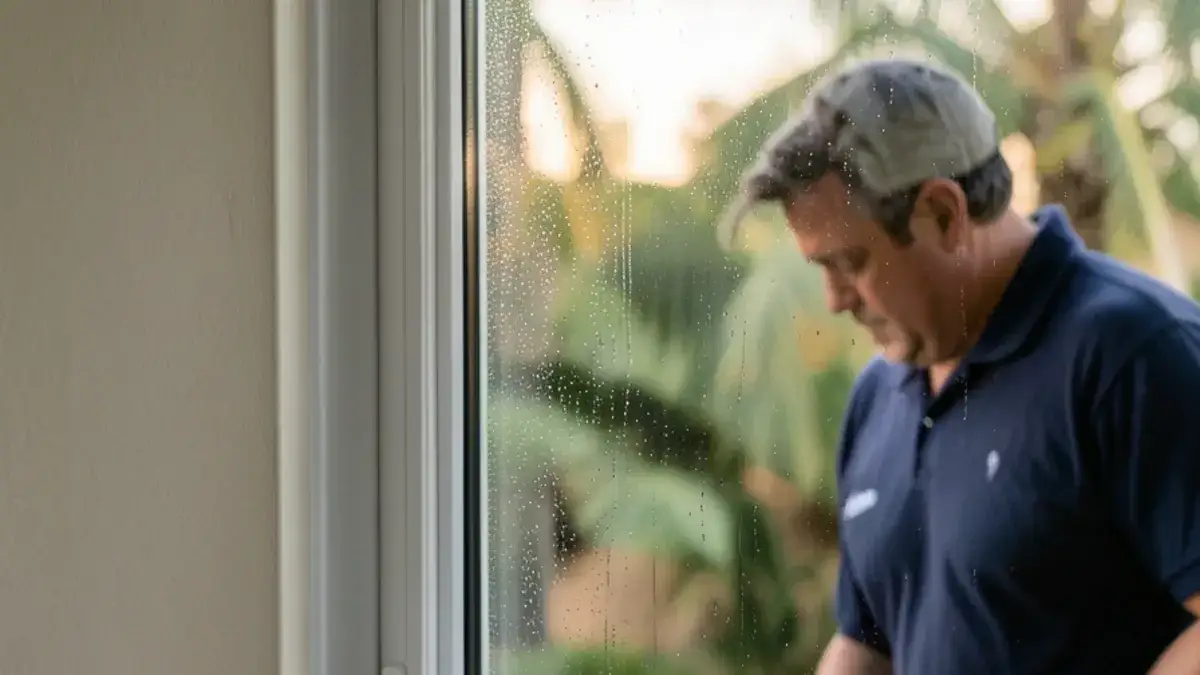
Mold and humidity in Florida go together because wet air slows evaporation, so a leak that might dry on its own in a dry climate can stay damp here. Mold needs very little water, and EPA's drying window is 24 to 48 hours. Near-saturated air makes that window hard to hit without dehumidification.
Why does wet air keep a leak wet?
Water leaves a wall only as fast as the air around it can take on vapor. In dry air that happens quickly. In air that is already holding most of what it can, evaporation slows to a crawl, and the drywall, framing and carpet pad stay damp for longer than anyone expects.
Mold needs that time. EPA calls moisture the most important factor in indoor mold growth and says mold needs little water, so even slight condensation can support it. Spores are already in the air of nearly every home, and EPA lists paper, cloth and wood among the organic materials mold can feed on. FEMA says colonies can start on a damp surface within 24 to 48 hours, which matches EPA's advice to dry water-damaged areas in that same window.
So humidity does not create mold by magic. It takes away your margin. A leak that a dry climate forgives gets no such grace here.
Leak in a humid house? Call us to measure what stayed wet
Open 24 hours for emergencies. Non-emergency calls are best between 7am and 7pm.
- 5.0 on Google, 8 reviews
- Family owned since 2020
- Calls go straight to the owner
- Free assessments and estimates
Which humidity numbers matter?
The gap between Florida's air and EPA's indoor target tells most of the story, and it is why a wet house rarely fixes itself.
| Reading | What it means | Source |
|---|---|---|
| 30 to 50 percent | Ideal indoor range | EPA |
| About 50 percent | Ideal indoor level for Florida homes | UF/IFAS Sumter County |
| 55 percent or lower | Indoor target in Florida Extension guidance | UF/IFAS |
| Below 60 percent | The indoor ceiling to stay under | EPA |
| 74.5 percent | Florida's statewide average relative humidity | UF/IFAS Sumter County |
| 80 to 100 percent | Possible nighttime outdoor humidity in Florida | UF/IFAS Sumter County |
Those outdoor figures leave a homeowner in a place like Fruit Cove, with the St. Johns River nearby, little to gain from fresh air. Air from outside is often wetter than the air you are trying to replace.
Why can a percent reading mislead you?
Percent humidity moves with temperature, so it can hide how much water the air really holds. The National Weather Service treats dew point as the better measure. Dew point is the temperature air must cool to before it reaches 100 percent humidity, and a higher dew point means more water in the air. The Weather Service's example is 80 degrees with a 60-degree dew point, which reads about 50 percent.
That changes two decisions in a wet house.
- Opening up. A hot afternoon at 60 percent can carry far more water than a 75-degree room at 60 percent, which has a dew point near 60. Your weather app shows the outdoor dew point, so compare that number and not the percent.
- Cold surfaces. Any surface below the dew point collects water, even in a room that reads fine on the gauge. That is how a chilled register sweats.
There is one honest exception to the closed-window rule. On a dry day behind a winter cold front, outdoor air can hold less water than the house. For a small clean spill you are drying yourself, that is a fair day to ventilate. It does not help a wet wall cavity, and we keep the house closed on a drying job because the equipment needs one body of air to work on.
Where does the air conditioner fall short?
It helps, but only while it runs, and it was not sized for a wet building. An AC system pulls moisture out as a side effect of cooling. Once a thermostat is satisfied, the compressor stops and so does the drying. That is why a house can feel cool and still hold a wet wall.
Power failures make this worse. UF/IFAS advises checking indoor humidity once power returns, since an outage stops both cooling and dehumidifying. Humidity also tends to run higher after hurricanes, especially with water standing around the home.
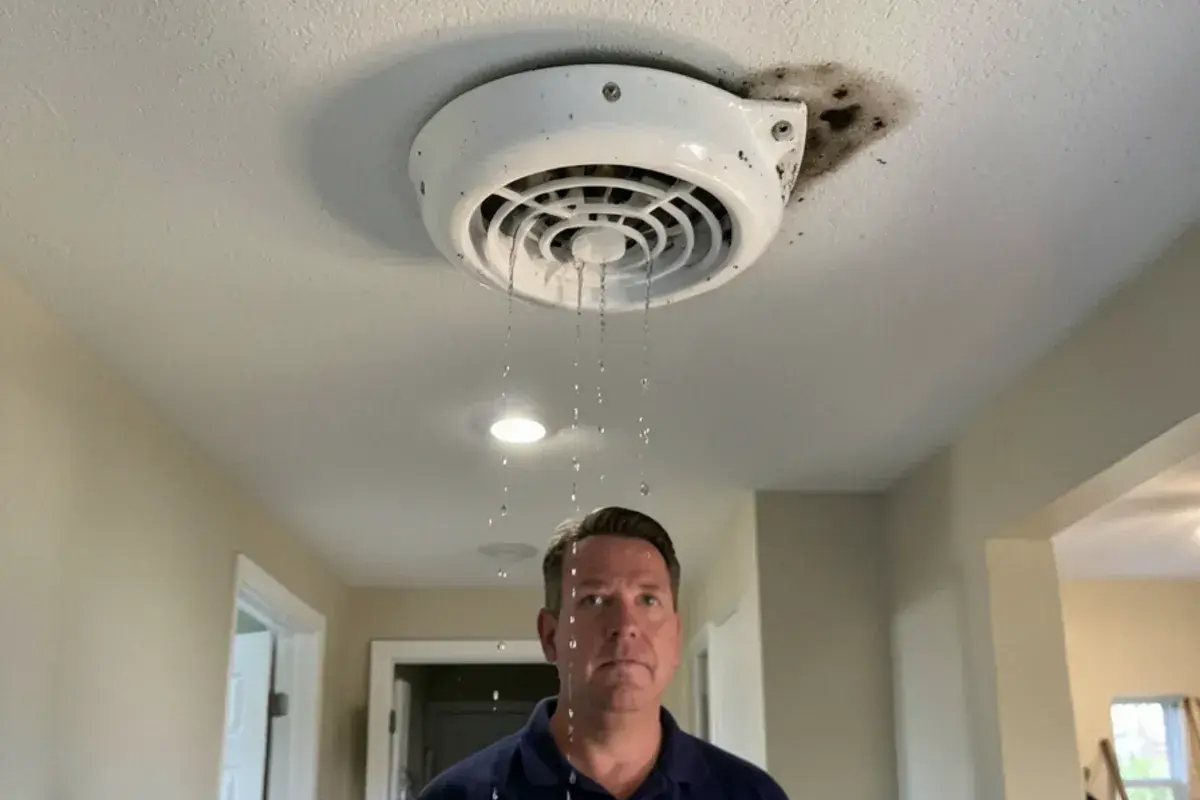
Cold surfaces are the other trap. EPA lists condensation from high humidity or cold spots among common moisture sources, and an over-cooled register in damp air can sweat. If you see beads of water on a supply vent after a leak, treat it as a sign that the air is still too wet.
How can you check the air in your own home?
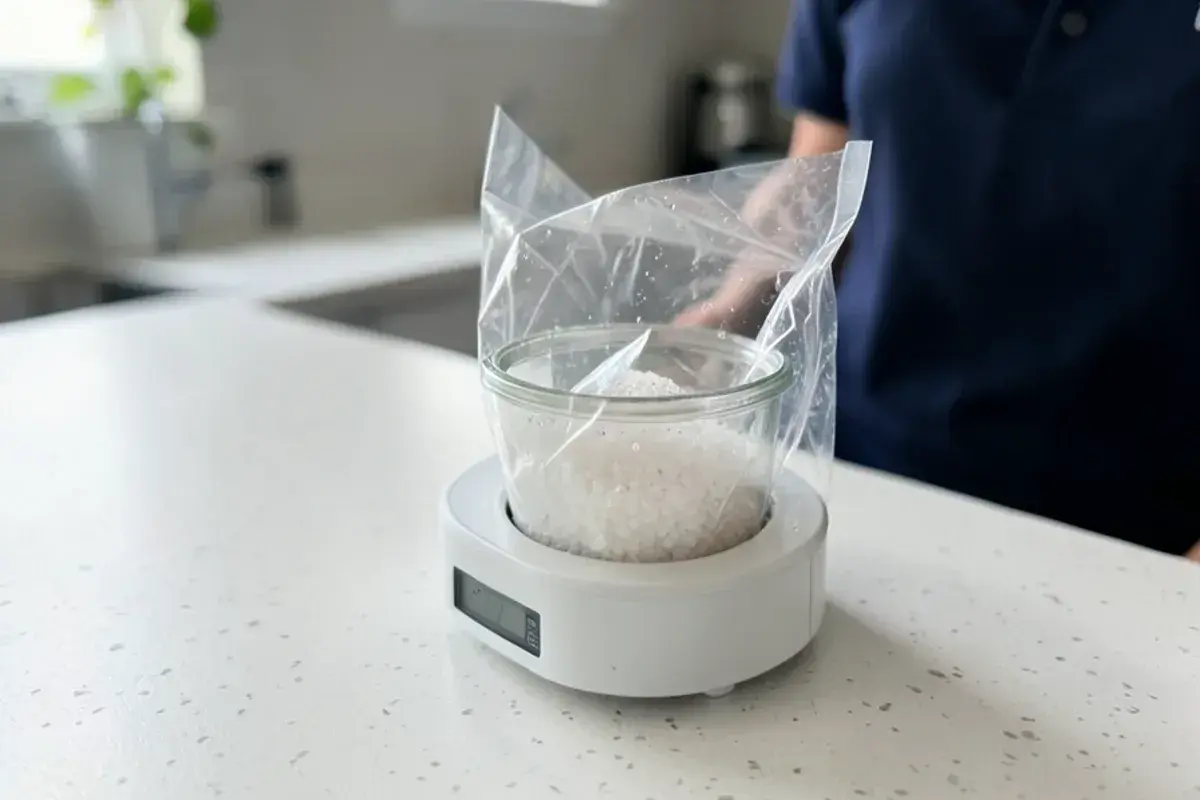
Measure it, and do not trust a gauge you have never tested. UF/IFAS warns that mechanical hygrometers are frequently off by more than 20 percent, which is the difference between fine and a problem. Here is the salt check it describes.
- Put a small cup of table salt, dampened with water, in a plastic bag.
- Seal the humidity gauge in the bag with it.
- Leave it for at least 12 hours.
- Look for a reading of 75 percent, and note any difference.
- Add or subtract that difference from every reading after this.
Then read the rooms that matter: closets on outside walls, the room with the leak and any bedroom that smells stale. Compare morning and evening. A room holding above 60 percent while the rest of the house sits near 50 is telling you something, and that something is usually moisture.
How we dry a wet house in wet air
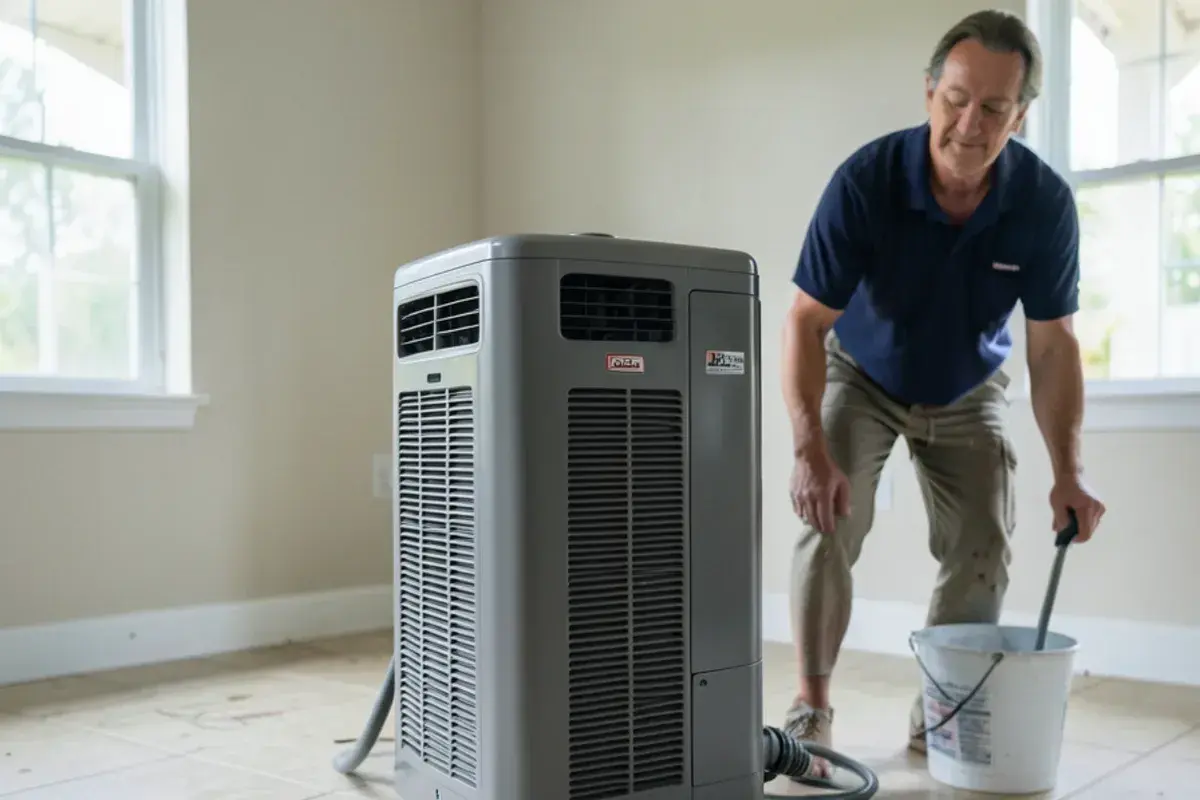
Dehumidification is the core of the job here. Air movers push moisture off surfaces, but that only loads the air, and without a way to take water out of that air the room just gets clammier. These are the rules we follow.
- Keep doors and windows closed so the equipment works on one body of air.
- Run LGR dehumidifiers sized to the room, not just fans.
- Open the wall when moisture is trapped behind a finish that will not release it.
- Take daily moisture readings on the same spots, and map them.
- Stop only when materials match the reading of unaffected ones nearby.
The dry standard matters more here than almost anywhere. Touch tells you nothing, because a wall can feel dry at the paint while the back of the paper stays wet. We use moisture meters and thermal imaging to find that difference, then decide whether structural drying can save the material or whether it has to come out.
Reading the air as well as the wall
Each visit we read temperature and humidity in the wet room, in an unaffected room and outside, and we compare them by dew point. The wet room should sit drier than the rest of the house. If it does not, the equipment is too small for the space, a door keeps getting opened, or water is still arriving, and the material readings tell us which.
Closed-room drying has a cost, and you should hear it from us first. The machines are loud, they give off heat that your AC has to carry, and the house stays shut for the length of the job. In August air we think that trade is worth it, because the slower alternative leaves materials wet longer.
If growth has already started, the job changes. Our page on mold after water damage covers containment and removal, and mold inspection explains how we find the moisture source. Lab sampling and formal assessment are separate and come from an independent licensed mold assessor.
A wall that feels dry still needs a number
A gauge tells you about the air, and a meter tells you about the material. In this climate you want both answers before anyone paints, closes a wall or calls the leak finished.
Had a leak in the last few weeks and never had the wall checked? Call us. Calls go straight to the owner, assessments and estimates are free, and we will tell you plainly whether anything stayed wet.
Frequently asked questions
Will opening the windows dry a wet room faster in Florida?
Usually not, and at night it often does the opposite. UF/IFAS notes that Florida nights can reach 80 to 100 percent humidity, and open windows let that air inside. Moving air helps only when the air itself can take on more water. Keep the windows shut, run the air conditioning if it is safe to use, and get dehumidification going in the wet room.
Does turning the AC down lower stop mold after a leak?
Not by itself. An air conditioner removes humidity only while it runs, and an oversized or short-cycling unit may leave the house cool and damp. Very cold surfaces can also collect condensation, which EPA says is enough moisture for mold. Do not run the system at all if you suspect the air handler or ducts are contaminated, because EPA warns that can spread mold through the building.
Is a bathroom that sits at 70 percent humidity a mold risk?
It is above the line EPA recommends, which is below 60 percent indoors. A short spike during a shower is normal. A room that stays there for hours points to a fan that is not moving air or a hidden moisture source. Run the fan through and after showers, then recheck. If the room stays high with the fan working, look for a leak behind the wall.
Worried a leak never fully dried? Call for a free assessment
Open 24 hours for emergencies. Non-emergency calls are best between 7am and 7pm.
- 5.0 on Google, 8 reviews
- Family owned since 2020
- Calls go straight to the owner
- Free assessments and estimates
1 Call Restoration, Saint Augustine, FL. (208) 464-4194.
Related services: Mold After Water Damage, Structural Drying, Mold Inspection and Assessment. Serving Fruit Cove and the rest of our service area.
Sources
- EPA, A Brief Guide to Mold, Moisture and Your Home
- EPA, Mold Course Chapter 1
- EPA, Mold Cleanup in Your Home
- FEMA, Dealing with Mold and Mildew in Your Flood Damaged Home
- UF/IFAS Extension Sumter County, Was your power out? Check indoor humidity, October 2022
- UF/IFAS, Water Wednesday Recap: Understanding Florida Homes
- National Weather Service, Dew Point vs Humidity
- National Weather Service, Heat Index